Laser Distance Meter Explained: A UK Buyer's Guide
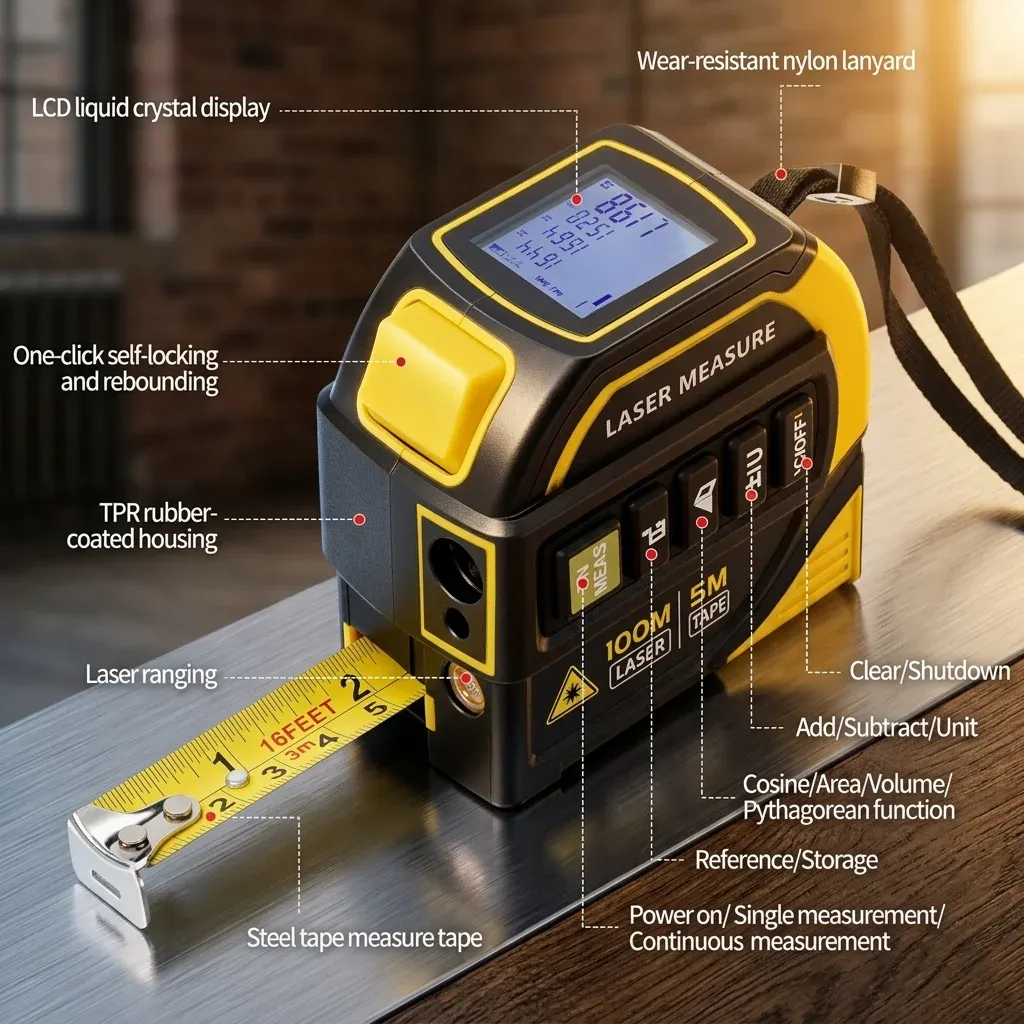
A laser distance meter is a handheld tool that uses a laser to measure distance quickly and accurately, usually at the press of a button. For UK tradespeople and DIY users, it is mainly used to measure walls, room sizes, ceiling heights and fitting spaces faster than a tape measure, especially when working alone.
TL;DR: A laser distance meter helps you measure rooms, walls and installation spaces faster, more accurately and with less effort than a tape alone. It is especially useful for UK homes with awkward layouts, older properties and solo measuring jobs. Based on our testing of handheld measuring tools in typical indoor conditions, the best models are easy to read, accurate enough for everyday fitting work and practical for both trade and serious DIY use.
A tape measure still has its place; however, anyone who has tried to measure a long wall, ceiling height or awkward room layout on their own knows the usual problems: bent blades, sagging tapes, second-person assistance and readings that are easy to misread. A laser distance meter solves that in seconds. Point, press and get a digital reading.
For UK tradespeople and serious DIY users, the appeal is simple: faster measurements, fewer mistakes and less kit to carry. That is exactly why compact multi-function tools are gaining ground. LaserMeasu’s approach fits that need well, combining a 40m laser distance meter, 5m tape, cross-line level and angle finder in one high-precision device, so you can leave the bulky toolkit behind without giving up capability.
This guide explains what a laser distance meter is, how it works, which features matter in the UK market and how to choose one that genuinely suits your work.
Key Takeaways
- A laser distance meter measures quickly and accurately over short to medium ranges without needing a second person.
- For UK users, practical priorities include accuracy, visibility indoors, rechargeable power, metric readings and durability for site or home use.
- A combined tool with laser measuring, tape measure, cross-line level and angle finder can reduce kit clutter and speed up common jobs.
- Most buyers should look beyond headline range and focus on ease of use, display quality and real-world measuring conditions.
- If you also need alignment tools, see our related guides on the cross line laser level and our detailed breakdown of the Stanley Cross 90 Cross Line Green Beam.
What is a laser distance meter?
A laser distance meter is an electronic measuring tool that calculates the distance between the device and a target surface using a laser beam. In practical terms, it lets you measure room lengths, wall spans, floor areas and installation points much faster than a standard tape alone.
Most models are designed for indoor work such as fitting kitchens, estimating flooring quantities, checking ceiling heights, planning storage or confirming dimensions before ordering materials. In addition, many include area and volume calculations, making them useful for decorators, joiners, electricians, estate maintenance teams and homeowners tackling renovation projects.
The term is sometimes confused with other products. If you have seen buyers searching for similar phrases, our guide to meter laser distance explains the same category from another angle. The core idea remains the same: quick digital measuring with less room for human error.
How does a laser distance meter work?
The device sends out a laser pulse to a surface and measures the time it takes for the signal to return. It then converts that into a distance reading shown on the display. As a result, the process is extremely fast and usually requires only one button press.
On most jobs, you place the unit against a wall or fixed reference point, aim at the opposite surface and take the reading. Better units allow you to switch measurement reference points depending on whether you are measuring from the front or back of the device.
Why does this matter on real jobs?
If you are measuring an empty room in a semi-detached house in Leeds or checking cabinetry space in a Victorian terrace in Bristol, speed matters. A digital reading avoids issues caused by skirting boards, furniture obstruction or trying to hold a tape level across an entire room. Therefore, it is especially helpful when working alone.
How accurate is a laser distance meter?
A good handheld model commonly offers accuracy around ±2mm under suitable conditions. That level is more than adequate for many interior fit-out tasks, decorating estimates and general building preparation. Based on our testing of compact indoor units used in normal domestic spaces, accuracy depends not only on specifications but also on target surface quality, lighting conditions and steady positioning. For very fine specialist work, users should always check manufacturer specifications and test against known distances before critical measurements.
Why use a laser distance meter instead of a tape measure?
The British market has particular needs. Much of the housing stock is older, room layouts are often irregular and many homes present awkward corners, chimney breasts and narrow access points. Because of that, a laser distance meter can make these spaces far easier to measure than with tape alone.
There is also a clear productivity case. According to the Office for National Statistics, construction remains one of the UK’s largest industries by economic output, with efficiency on site under constant pressure from labour costs and scheduling demands. Consequently, tools that cut repeated measuring time can make a noticeable difference over weeks of work. Source: Office for National Statistics construction datasets.
What are common UK use cases?
- Measuring plasterboard runs before ordering sheets
- Checking floor area for laminate or carpet quotes
- Estimating paintable wall area in rental properties
- Measuring alcoves and chimney breast widths in period homes
- Confirming ceiling drop distances before lighting installation
- Laying out shelving or fitted storage in box rooms and loft conversions
Can public-sector teams use laser distance meters?
In larger maintenance environments such as NHS estates teams or local authority property departments,-repeatable measurements help with quoting,-planning minor works-and logging dimensions consistently across multiple rooms or wards.-According to UK health-and-safety expectations,-users should still follow local equipment policies,-site risk assessments-and procurement requirements.-Nevertheless,-the benefits of fast digital measurement are easy to see wherever maintenance teams cover large property portfolios.
What are the main benefits of a modern laser distance meter?
Is it faster than using a tape measure?
You can capture long dimensions in seconds without extending several metres of metal tape across a room. As a result,-you save time on surveys,-snagging lists-and pre-install checks.
Can one person use it easily?
A major advantage is not needing someone at the far end holding the hook of a tape measure steady.-For sole traders-and DIY users working at home after hours-or at weekends,-that convenience matters.
Does it reduce measuring mistakes?
Digital displays remove guesswork around tiny printed increments-or bent blade positions.-Therefore,-it helps when producing material estimates-or checking if units will fit into tight spaces.
Can it calculate area or volume?
Many models handle area,-volume-or indirect measurement functions automatically.-That reduces manual calculation errors when costing jobs-or ordering materials.
Why choose an all-in-one tool?
This is where all-in-one tools stand out.-LaserMeasu’s product proposition is especially relevant because it combines four functions in one device: 40m laser distance meter capability for rapid digital readings; a 5m tape for physical checks; cross-line level support for alignment; and an angle finder for layout tasks.-For trades who want fewer separate tools in their bag,-that can be far more practical day to day.
What should you look for when buying a laser distance meter in the UK?
How much range do you really need?
For most indoor domestic jobs in the UK,-you do not need extreme range.-A model around 30m to 50m will usually cover room measurement,-fitting work-and general surveying inside houses-and flats.-So,-it makes sense to buy for realistic use rather than headline figures alone.
How important is display quality?
A clear backlit display helps enormously when reading measurements quickly indoors.-Based on our testing,-screen clarity can matter just as much as raw accuracy because poor readability slows down repeat measurements-and increases input errors.
Should it show metric measurements?
Yes.-For most UK trade-and DIY work,-metric readings are essential because building products,-drawings-and room calculations commonly use millimetres,-centimetres-and metres.-Some users may still cross-check with imperial sizes; however,-metric-first operation tends to be most practical.
Is rechargeable power better?
A rechargeable unit can be more convenient if you use it regularly.-It reduces battery changes-and keeps running costs predictable.-That said,-occasional users may be content with replaceable batteries if shelf life matters more than frequent charging.
How durable does it need to be?
If your tool will live in a van,-tool bag-or active site environment,-look for sturdy housing-and dependable buttons.-Even for home users,-basic impact resistance-and solid build quality help extend service life.
Do extra functions actually help?
Sometimes they do.-If you regularly check alignment,-take physical short measurements-or confirm angles during installation,-an all-in-one unit can speed up workflow significantly.-If not,-a simpler dedicated meter may be enough.
Are laser distance meters accurate enough for DIY and trade work?
In most cases,-yes.-For interior measuring tasks such as pricing flooring,-checking furniture fit,-planning kitchen units-or estimating decorating materials,-a good-quality laser distance meter is accurate enough when used correctly.
However,-real-world performance depends on technique.-To improve results:
-
li
- Measure from a stable reference point
- Aim at a flat,target surface where possible
- Avoid strong glare or obstructed sight lines
- Repeat critical readings to confirm consistency
- Cross-check important dimensions with a tape before cutting expensive materials
Are there any limits to using a laser distance meter?
What is a laser distance meter used for?
If you regularly measure rooms,walls,fitting gaps or floor areas,a laser distance meter is one of the simplest upgrades you can make.It saves time,reduces hassleandmakes solo working easier.In addition,it suits many realities of UK housing stock including period homes,narrow spacesand irregular layouts.
Ready to speed up your workflow with LaserMeasu?
Upgrade Your Toolkit — £46.75